





31 Aug Unreasonable hospitality in dentistry and when exceptional becomes expected
Unreasonable Hospitality, the hedonic treadmill and why better service is not always about giving people more
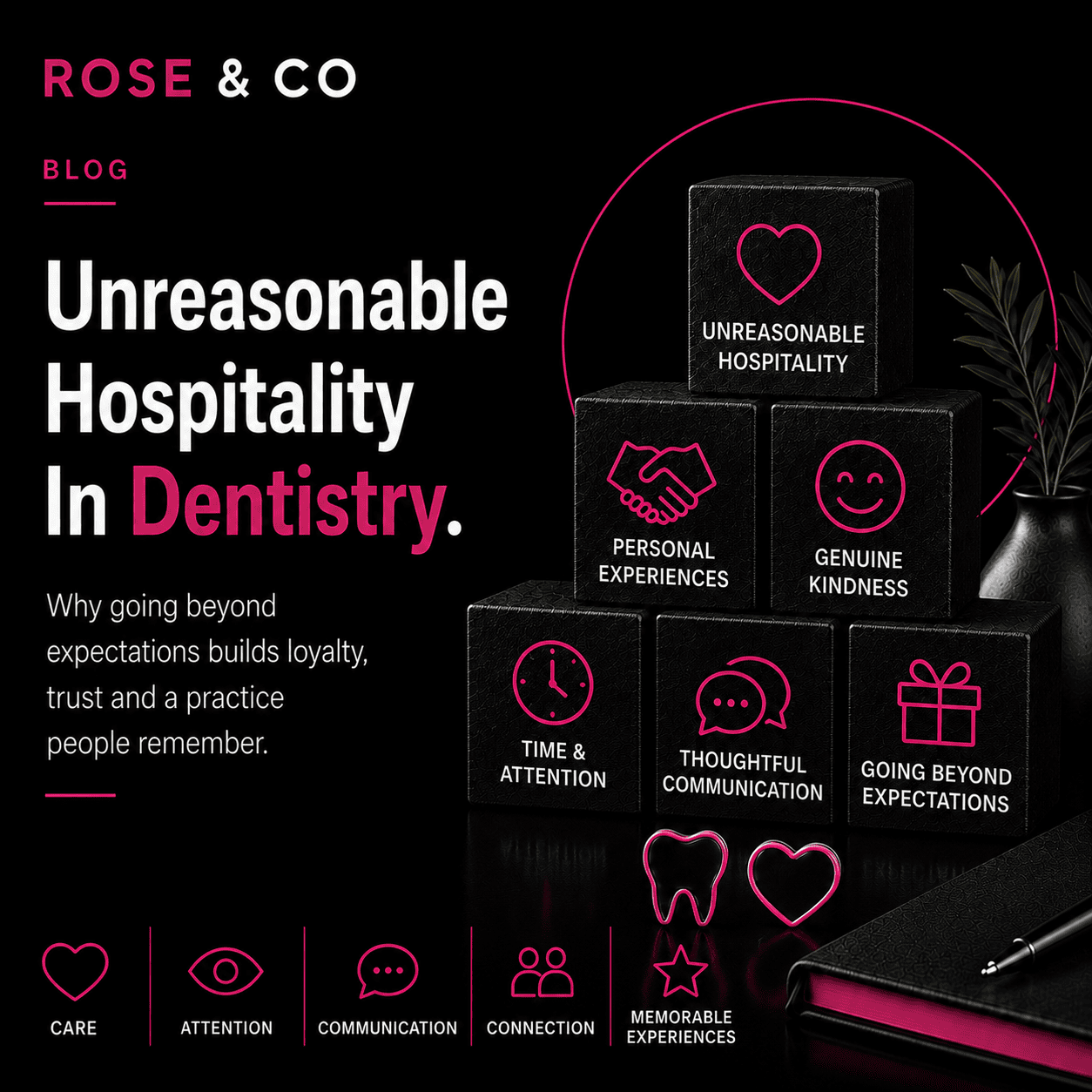
I love the idea of unreasonable hospitality, not because dental practices need to behave like luxury hotels, or because every patient needs a gift. I love it because, at its heart, it is about noticing people.
Will Guidara’s idea is that ordinary service can become memorable when we pay enough attention to understand what would genuinely matter to the individual in front of us. It’s good advice, and when applied sensibly in a dental practice, it gives us some direction, such as speaking to a patient when they prefer it, slowing down when someone looks overwhelmed, or simply giving a patient permission to think before making a decision. But there is a useful tension here, one that psychology helps us understand.
The problem with exceptional
Brickman and Campbell’s hedonic treadmill describes our tendency to adapt to improved circumstances. The new car becomes just the car, the new surgery becomes the normal place where we work, and the service improvement that once delighted patients can quietly become the minimum they expect this year. The risk for practices is that the race to ‘give people more ’ confuses us about what great hospitality really is. More is not the same as better.
“Don’t keep trying to impress people. Keep getting better at noticing them.”
At Rose & Co. we keep coming back to the belief that great service is individual. So the better question is not ‘What else can we give our patients?’ It is ‘What would matter to this patient?’
Perhaps a better phrase might be ‘intelligent hospitality’ because for one person, unreasonable hospitality might be a thoughtful gesture. For another, it might be being seen on time, and noticing that requires attention, intelligence and application. The gesture is therefore not the point, whereas it’s the thinking behind it that matters.
Patients bring their own reference points
The hedonic treadmill also reminds us that patients never experience a practice in isolation. They bring previous dental experiences, expectations, fears and assumptions with them. Something we regard as exceptional may already feel normal to them and what we regard as routine may feel enormously significant. We cannot decide what exceptional feels like on somebody else’s behalf. That is why curiosity matters. The more closely we listen, the more likely we are to understand what will actually improve this person’s experience rather than simply adding more to it.
The lesson for dental practice owners and their teams
Practice owners can also find themselves on the hedonic treadmill too. The turnover target is reached, the team grows, another surgery opens, and very quickly the achievement becomes the new baseline, quickly followed by a more demanding target. And it’s not that growth or ambition are wrong, but it is worth occasionally asking whether achieving the next thing becomes your new normal, and what you are really pursuing it for.
It can be the same for teams too, because they adapt, but better systems, new technology, and benefits can all become the norm. That does not make people ungrateful, it makes them human, which is why recognition has to be ongoing, specific and personal. People need to feel seen, valued and valuable, not simply provided for.
Perhaps hospitality is simpler than we think
Maybe the most unreasonable thing in an increasingly automated and transactional world is to pay proper attention to another human being. To notice, listen, remember, understand what matters, and then to do something meaningful with what we have noticed.
Systems and technology can help us create consistency, but they should free us to be more human, not replace the need to be human.
Good leadership is not an endless pursuit of more. It is the ability to notice what matters, understand changing expectations, recognise progress and keep creating experiences with meaning. Unreasonable hospitality does not mean continually raising the amount we give. It means continually deepening our understanding.
Sorry, the comment form is closed at this time.